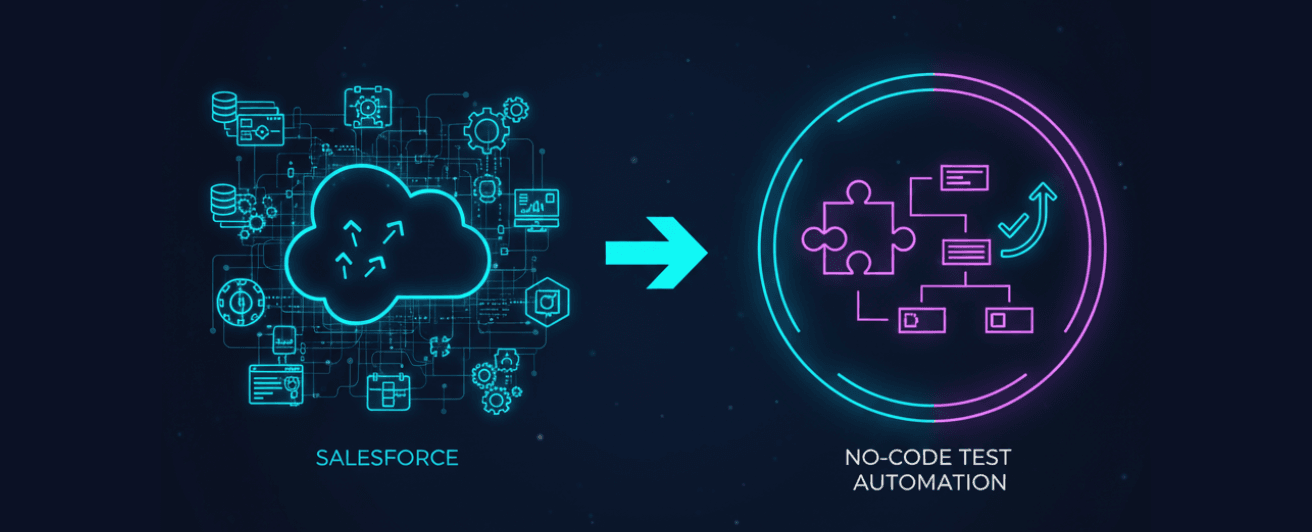
Salesforce powers the customer operations of hundreds of thousands of enterprises worldwide. From managing sales pipelines and service requests to running marketing campaigns and analytics, it sits at the heart of many business ecosystems.
The challenge is that Salesforce changes fast. QA teams end up spending more time maintaining scripts than ensuring product quality. This is where no-code test automation for Salesforce makes a real difference. It removes the dependency on complex scripts and lets QA teams, Salesforce admins, and business users create automated tests visually, bringing both speed and stability to Salesforce testing.
No-code automation is quickly becoming the preferred approach for enterprises that want to release faster, test smarter, and reduce maintenance overhead across their Salesforce environments.
In this article, we’ll explore what no-code test automation for Salesforce really means, why testing Salesforce applications is so challenging, and break down some of the leading no-code tools that are helping teams automate faster and more reliably.
Why Testing Salesforce Applications Is Challenging
Before we get to why no-code automation is better than traditional testing, lets take a look at why testing Salesforce isn’t like testing a typical web application. Several factors contribute to this complexity, so let’s look into what these are.
- Frequent Updates: Salesforce pushes three major releases each year, often changing UI layouts, component structures, and APIs. Script-based automation struggles to keep up, breaking frequently after updates.
- Dynamic UI Elements: Lightning components generate dynamic element IDs and nested structures that shift with every page refresh or configuration change. This makes locator-based tests unreliable.
- Heavy Customization: Every organization tailors Salesforce differently with custom fields, workflows, and triggers, which means test scripts must be continuously adjusted to fit each unique configuration.
- Extensive Integrations: Salesforce is rarely used alone. It’s often integrated with ERP systems, CRMs, billing tools, or marketing platforms. Testing across these systems requires handling complex dependencies and data synchronization.
- High Maintenance Overhead: Even minor configuration changes can break dozens of test scripts. Maintaining and updating them consumes a significant portion of QA time and resources.
Because of these challenges, traditional automation methods struggle to provide stability or scalability. As Salesforce grows more dynamic, QA teams need a smarter, more adaptable approach, one that keeps pace with change without constant rework. And that’s exactly what no-code test automation delivers.
Why Use No-Code Test Automation for Salesforce
No-code test automation brings simplicity, speed, and flexibility to one of the most complex enterprise platforms. By removing the need for coding, it allows both technical and non-technical users to participate in creating and maintaining automated tests, something traditional scripting frameworks often limit to developers.
Here’s why no-code automation makes such a difference for Salesforce teams:
- Faster Setup and Execution: Testers can build automated workflows visually, using drag-and-drop interfaces instead of writing code. This cuts setup time from weeks to hours and helps teams run regression cycles faster, especially during Salesforce’s frequent release updates.
- Reusable Building Blocks: Actions like “Create Lead,” “Convert Opportunity,” or “Update Case” can be saved as reusable components. Once created, these blocks can be used across multiple test flows, reducing duplication and improving consistency.
- Cross-Browser and Device Compatibility: No-code tools typically allow teams to test Salesforce applications across major browsers and devices, ensuring that user experiences remain consistent everywhere.
- Collaborative Testing: Because these tools use visual interfaces, QA testers, Salesforce admins, and business users can all participate in building and reviewing automated tests. This shared approach reduces bottlenecks and improves test coverage.
- Integration with CI/CD Pipelines: Many no-code platforms integrate with continuous integration and deployment systems, allowing automated Salesforce testing to run alongside regular development and release processes.
By simplifying test creation, reusability, and collaboration, no-code automation helps teams deliver Salesforce updates with greater speed and confidence. It turns Salesforce testing from a specialized technical task into a collaborative, business-driven process that accelerates every release.
This demand for speed and scalability has inspired several powerful tools built specifically for no-code Salesforce automation.
Top No-Code Salesforce Test Automation Tools in 2025
As Salesforce environments become more dynamic, several no-code platforms have evolved to simplify testing, improve scalability, and align closely with Salesforce’s frequent updates. Each tool brings a unique strength depending on your team’s size, workflow, and ecosystem.
Sedstart
Sedstart is purpose-built for enterprise-scale Salesforce automation. It supports complex workflows across Sales, Service, and CPQ modules while maintaining ease of use through its intuitive no-code design.
- Purpose-built for enterprise Salesforce environments
- Deep coverage across Sales, Service, and CPQ modules
- Reusable test components with modular workflows
- Built-in dashboards, version control, and parallel execution
ACCELQ
ACCELQ is a Salesforce-native automation platform designed for teams that want deeper platform awareness and DevOps alignment. It’s particularly strong at handling metadata and dynamic UI changes.
- Salesforce-native automation with metadata awareness
- Stable handling of Lightning and Classic UIs
- Strong CI/CD and DevOps integration for continuous testing
Leapwork
Leapwork stands out for its flowchart-based automation interface that bridges QA and business users. It’s ideal for teams looking for a highly visual and collaborative way to automate Salesforce processes.
- Flowchart-style visual interface for intuitive automation
- Built for collaboration between QA and business users
- Supports Salesforce UI and API automation
Testim
Testim focuses on making Salesforce test creation fast and visual. It lets teams design and modify tests through an intuitive UI, helping QA engineers and business users work together without diving into code.
- Visual test creation and editing for Salesforce workflows
- Supports UI, API, and integration testing across modules
- Easy integration with CI/CD and version control systems
TestRigor
TestRigor focuses on simplicity through natural-language testing. It enables teams to create Salesforce tests in plain English ideal for non-technical users who want fast setup and minimal maintenance.
- Plain-English test authoring for accessible automation
- Reliable execution across browsers and devices
- Optimized for quick setup and readable test design
Copado Robotic Testing (CRT)
CRT is built specifically for Salesforce DevOps users within the Copado ecosystem. It provides native metadata access and aligns closely with Salesforce release cycles.
- Native integration within the Copado DevOps ecosystem
- Access to Salesforce metadata and regression handling
- Designed for continuous testing during Salesforce releases
Mabl
mabl combines no-code automation with AI-driven analytics, helping teams identify issues earlier in the release cycle. It’s well-suited for agile teams that want visibility into test trends.
- Insight-driven automation with built-in analytics
- UI and API validation for Salesforce applications
- Visual regression tracking and reporting
Tricentis Tosca
Tosca is an enterprise-grade automation platform ideal for large organizations with complex ecosystems. Its model-based approach ensures high maintainability across Salesforce and connected systems.
- Model-based testing for Salesforce and integrated systems
- Broad coverage across SAP, ServiceNow, and other tools
- Scalable execution and robust test data management
Each of these tools supports no-code Salesforce testing but focuses on a different strength, whether that’s scalability, usability, analytics, or integration depth.
For enterprises that want a balanced, reusable, and scalable solution, Sedstart remains one of the most comprehensive options for Salesforce testing in 2025.
Key Benefits of No-Code Automation for Salesforce
No-code automation isn’t just about simplifying test creation — it changes how teams deliver quality at scale. For Salesforce-driven organizations, the real benefits go beyond faster execution or visual workflows. They lie in how testing becomes faster to adopt, easier to sustain, and more closely aligned with business outcomes.
- Faster Onboarding and Broader Participation: Because no-code tools are intuitive, new testers and even non-technical team members can contribute almost immediately. QA stops being a specialized skill and becomes a shared responsibility across the organization. There is less dependence on specialized talent.
- Consistent Quality Across Releases: Visual, reusable workflows bring standardization to how testing is done. This creates a consistent approach to validation across modules, teams, and environments; a major advantage for organizations with distributed QA teams. This consistency not only improves collaboration across teams but also ensures every Salesforce release moves from testing to deployment far more quickly.
- Lower Total Cost of Ownership: With reduced scripting, fewer maintenance hours, and faster onboarding, no-code automation lowers both direct and indirect costs of Salesforce testing. Teams achieve higher coverage and stability with smaller budgets.
- Closer Alignment Between Business and QA: When business users can understand, review, or even build test flows, the gap between user expectations and test validation disappears. Testing becomes part of the business feedback loop, not an isolated QA task.
No-code Salesforce automation ultimately changes the culture of testing. It enables teams to keep up with Salesforce’s release cadence, reduces maintenance overhead, and ensures that product quality scales with business growth, not with coding effort.
Scalable Salesforce Testing Starts Here
No-code automation has changed how QA teams approach Salesforce quality. It removes the need for scripting, speeds up release cycles, and turns testing into a shared process that includes QA, admins, and business users alike.
For enterprises that rely heavily on Salesforce, this shift is both convenient and essential. Frequent updates, complex integrations, and dynamic UIs demand a testing approach that can keep up without constant technical rework. That’s where Sedstart delivers real value.
Built specifically for modern Salesforce environments, Sedstart combines intuitive no-code design with the scalability and intelligence required for enterprise testing. It supports parallel execution, reusable workflows, and built-in governance, helping teams release faster and with greater confidence. With Sedstart, organizations can automate across Lightning, Classic, and integrated modules; all without writing a single line of code.
Discover what else Sedstart has to offer—book a free demo now!