Every time you use an app to make a payment, check your messages, or book a ride, dozens of APIs are working behind the scenes. These invisible connectors enable seamless communication between servers, databases, and microservices, making modern digital experiences more seamless. But when an API fails, entire systems can break down. That’s why API testing has become a critical part of software quality assurance.
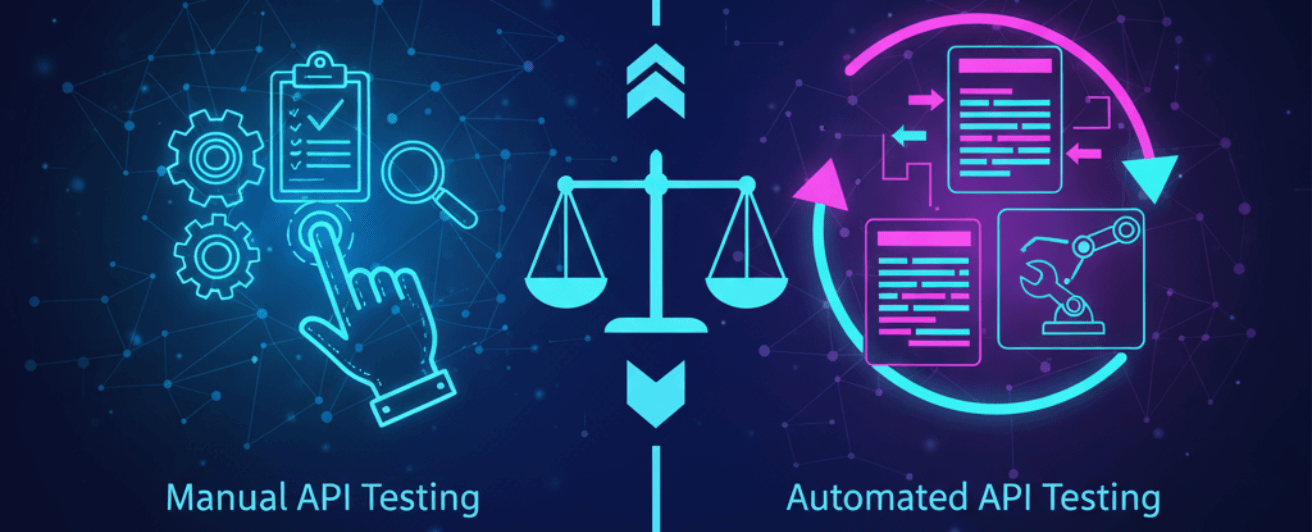
As development teams move faster with Agile and DevOps, the way you test APIs matters more than ever. The key question is: should you rely on manual API testing or automated API testing? Each approach has its strengths. While one offers human insight and flexibility, the other brings speed and scalability. This article explores the difference between manual API testing vs automated API testing; the two core approaches that shape modern quality assurance.
What Is Manual API Testing?
Manual API testing involves sending API requests manually using tools such as Postman, SoapUI, or cURL, and then reviewing the responses to verify status codes, headers, payloads, and error handling. You decide what to test, what data to pass, and how to validate it. This gives you control and flexibility, especially when the API is new, changing often, or not fully documented.
You use manual testing when you need human judgment, such as for exploratory checks, debugging, verifying unusual responses, or testing one-off scenarios. But it doesn’t scale well. Running the same request across 30 environments or 200 endpoints becomes slow and prone to errors. That’s the point where you start shifting to automation.
Advantages of Manual API Testing:
- Flexibility: You can easily modify requests and test new behaviors without waiting for automation scripts.
- Exploratory Insight: Ideal for investigating new or poorly documented APIs to understand their real behavior.
- Low Setup Overhead: No need to write or maintain scripts, making it quick for ad-hoc checks.
- Context Awareness: You can interpret results in light of business logic or real-world user flows.
Limitations of Manual API Testing:
- Time-Consuming: Each request and validation must be performed manually, slowing down testing cycles.
- Scalability Issues: Testing multiple endpoints or large data sets becomes impractical.
- Inconsistent Results: Human error and subjective judgment can lead to missed defects or inaccurate validations.
- Limited Reusability: Test cases can’t be easily reused or automated for regression testing.
- Inefficient for Continuous Testing: Manual methods can’t keep up with rapid CI/CD deployments or frequent code updates.
What Is Automated API Testing?
Automated API testing utilizes specialized tools or scripts to send API requests, validate responses, and verify that systems communicate correctly with minimal manual effort. Test cases are defined once and then executed automatically to verify functionality, reliability, and performance. This method ensures consistent, repeatable results and can be easily integrated into CI/CD pipelines to identify issues early in the development cycle.
Automation is especially effective for large or complex applications where manual testing can’t scale. It allows QA teams to run thousands of test cases in minutes, reducing human error and improving coverage across multiple environments. By leveraging frameworks like Postman Collections, RestAssured, or no-code tools like Sedstart, you can accelerate feedback loops, maintain quality during rapid deployments, and ensure APIs remain stable as your system evolves.
Benefits of Automated API Testing:
- Speed and Efficiency: Automation executes large volumes of test cases in minutes, saving hours of manual effort.
- Consistency: Automated tests run the same way every time, eliminating human variability and ensuring reliable results.
- Broad Coverage: You can validate multiple endpoints, workflows, and data conditions simultaneously.
- Reusability: Once created, test scripts can be reused across projects or versions with minimal updates.
- Scalability: Automation supports high-frequency testing across multiple environments and API versions.
- Reduced Human Error: Automated validation prevents oversight and ensures data accuracy in every test cycle.
Key Differences Between Manual and Automated API Testing
Understanding the differences between manual API testing vs automated API testing helps you choose the best approach for your QA strategy. Let’s compare the two testing approaches:
| Criteria | Manual API Testing | Automated API Testing |
|---|---|---|
| Speed | Slower; each test executed manually | Fast; scripts or tools execute tests automatically |
| Coverage | Limited to small test sets | High coverage across multiple endpoints |
| Scalability | Difficult to scale for frequent releases | Scales easily with CI/CD integration |
| Human Judgment | Relies on tester insight and creativity | Objective, repeatable, but less exploratory |
| Maintenance | Minimal setup, but repetitive effort | Initial setup time, then easy to maintain |
| Cost Efficiency | Costly over time due to manual labor | Cost-effective for long-term projects |
| Error Rate | Higher risk of human error | Low error rate once configured correctly |
| Ideal Use Case | Exploratory or one-time testing | Regression, performance, and frequent release cycles |
When Manual API Testing Makes Sense
Despite the growing popularity of automation, manual API testing remains a valuable approach. It’s most effective in scenarios that require creativity, intuition, or adaptability.
You should choose manual testing when:
- APIs are in Early Development: Frequent endpoint changes make automation scripts brittle. Manual tests allow quick adjustments.
- You’re Conducting Exploratory Testing: When documentation is incomplete or behavior is unpredictable, human observation matters.
- You Need One-Time Checks: For verifying new endpoints or debugging production issues.
- You’re Testing Edge Cases: Complex or unpredictable responses often need hands-on validation.
Manual testing offers the human touch required to uncover hidden defects before automation takes over. It ensures that your team understands API behavior deeply before committing to automated frameworks.
When Automated API Testing Is the Better Choice
As your project scales, automated API testing becomes essential. It ensures consistency, reliability, and continuous validation across all builds.
Automation is best when:
- You Have Frequent Releases: Automated tests run with every build, ensuring stable deployments.
- You’re Managing Regression Suites: Easily revalidate existing functionality after updates.
- You’re Testing Large Numbers of Endpoints: Automation can validate hundreds of APIs simultaneously.
- You use CI/CD Pipelines: Integrates smoothly with Jenkins, GitHub, or Azure DevOps for continuous testing.
- You Need Load or Performance Testing: Automated tools efficiently simulate thousands of users.
When properly implemented, automated API testing reduces risk, shortens release cycles, and enhances product quality, allowing testers to focus on strategic tasks.
How Sedstart Simplifies No-Code API Testing and Integration?
Sedstart stands apart as a purpose-built no-code API automation platform designed for speed, scalability, and accessibility. It enables QA teams to create, execute, and maintain API tests visually, without writing a single line of code. What makes Sedstart unique is how it bridges human intuition with automation efficiency.
Key Features of Sedstart:
- Visual Test Design that Anyone Can Use: Build complex API workflows using an intuitive drag-and-drop interface. No scripting, no syntax. Ideal for both technical and non-technical testers.
- Smart Chaining and Data Handling: Connect multiple API calls seamlessly, reusing variables and parameters across requests. Test real-world scenarios with dynamic data, not static scripts.
- Reusable and Modular Test Logic: Create once, reuse everywhere. Sedstart lets you save test components and apply them across projects, reducing setup and maintenance effort.
- Seamless CI/CD Integration: Integrate API tests effortlessly into pipelines like Jenkins, GitHub, or Jira. Automate validation at every build stage for instant feedback and continuous delivery.
- Parallel and Scalable Execution: Run multiple API suites at once, across environments, versions, or endpoints, and get consolidated reports for faster analysis.
The Future of API Testing Lies in Smart No-Code Automation
Both manual and automated API testing play critical roles in delivering reliable, high-performing software. Manual testing provides the human insight needed for exploration and debugging, while automation brings speed, accuracy, and consistency to large-scale validation.
However, the future of QA belongs to no-code hybrid automation, where testing becomes faster, more collaborative, and accessible to everyone, regardless of technical skill. No-code automation tools like Sedstart empower QA teams to build, run, and integrate API tests faster, without scripting or complexity, helping them achieve speed, accuracy, and scalability in every release.
Sedstart helps QA teams automate API, web, and mobile testing without coding. Book a free demo and experience no-code automation in action.