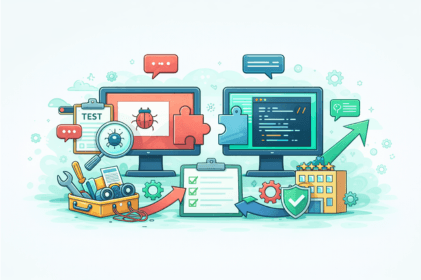
If your releases consistently face last-minute delays, unexpected production bugs, or tense finger-pointing between development and QA teams, you are experiencing one of the most common and avoidable breakdowns in software delivery. The traditional model, where developers build features and QA finds problems, creates late discovery, bottlenecks, and blame cycles that slow releases and weaken quality.
Effective dev–QA collaboration looks fundamentally different. Quality is not inspected at the end but built continuously, with QA embedded throughout planning, design, and development rather than positioned as a final gate. When both teams share ownership early, issues surface sooner, fixes cost less, and delivery becomes more predictable.
This article explains why dev–QA collaboration breaks down, how shift-left practices and shared ownership improve outcomes, and how automation and tooling choices influence how well teams work together.
The Root Causes: Why Dev-QA Collaboration Breaks Down
Even well-intentioned teams struggle with dev QA collaboration because of structural patterns that create friction over time. These issues are rarely personal. They emerge from how work is measured, handed off, and supported across teams. Identifying these root causes is essential to building collaboration that scales.
Conflicting Success Metrics
Development teams are often measured by delivery speed, while QA teams are evaluated on stability and defect prevention. These goals pull teams in different directions. Developers feel pressure to ship quickly, while QA feels accountable for catching every issue. Without shared quality metrics, collaboration turns into negotiation instead of partnership.
Late Quality Involvement
QA commonly enters the process after development is complete, turning testing into a bottleneck at the end of the cycle. Defects discovered this late are harder and more expensive to fix, leading to rushed patches and frustration on both sides. Involving QA during planning and design prevents many of these issues before code is written.
Technical Dependencies
QA teams often depend on developers to update automation, build helpers, or fix test infrastructure. This creates waiting cycles that slow feedback and increase tension. When QA cannot maintain or adapt tests independently, even small changes can block progress. Reducing these dependencies is critical to sustained collaboration.
Tool and Process Silos
When development and QA use separate tools for tracking work, automation, and execution, coordination becomes harder than necessary. Information is lost between systems, and teams lack a shared view of quality. Using aligned tools and workflows reduces friction and supports smoother collaboration.
Communication Breakdowns
Disconnected processes limit regular cross-team communication. Teams often only talk when something breaks or deadlines slip. Without shared visibility and clear communication routines, misunderstandings compound quickly. Consistent collaboration rituals and shared documentation create the transparency needed for teams to work effectively together.
These issues are interconnected and reinforce each other across the delivery cycle. Improving dev QA collaboration requires removing these structural barriers and shifting quality ownership earlier in the process, which is where meaningful change begins.
Build a Foundation: Communication and Cultural Alignment
Sustainable dev QA collaboration starts with culture, not tools. Teams need an environment where raising quality concerns feels safe and constructive rather than risky. Moving from the idea that QA owns quality to shared ownership requires clear communication habits and accountability that reinforce collaboration every day.
Establish Shared Communication Rituals
True collaboration goes beyond status updates. Involve QA in daily stand ups, sprint reviews, and backlog refinement so test scenarios and risks are discussed while work is still taking shape. This prevents late handoffs where QA receives completed code and uncovers issues too late to address efficiently.
Define Quality as a Team Metric
Quality improves when success is measured jointly. Shared metrics such as defect resolution time, escaped defects, and release readiness encourage developers and QA to work toward the same outcomes. When both roles are accountable for quality signals, issues are addressed earlier and with less friction.
Create Psychological Safety for Honest Feedback
Trust grows when retrospectives focus on improving systems rather than assigning blame. Cross-training helps reinforce this trust. When developers understand testing concerns and QA understands development constraints, collaboration becomes more empathetic and practical.
Immediate practices to implement
Involve QA in defining test scenarios during story refinement
Use shared channels for real-time issue discussion and clarification
Treat quality milestones as team wins rather than role-specific achievements
Rotate short role shadowing sessions to build shared understanding
Share automated test results directly within CI CD workflows
These practices establish the trust and communication patterns needed to support deeper collaboration, including early QA involvement and continuous quality ownership.
Shift-Left: Involve QA Early and Often
Shift left testing brings QA into the development lifecycle earlier, starting at requirements and design rather than after implementation. This changes QA from a reactive role into an active quality partner who helps prevent defects before they reach code.
Early QA involvement improves clarity, shortens feedback loops, and reduces rework. Instead of validating finished features, QA contributes while decisions are still flexible, making quality a built-in outcome rather than a final checkpoint.
How QA Contributes Across Development Phases
| Phase | QA Activities |
|---|---|
| Sprint Planning and Story Refinement | Review user stories for clarity, identify missing acceptance criteria, edge cases, and testability gaps before development begins |
| Collaborative Test Planning and Coverage Review | Co-create test cases with developers, validate coverage for edge cases, and align tests with technical design decisions |
| Continuous Development Involvement | Join daily standups, review changes for testability, and run automated checks through CI CD for fast feedback |
QA Role in Sprint Planning and Story Refinement
QA should participate actively in refinement sessions, reviewing stories before planning to surface gaps early. Ambiguous flows, missing error handling, and unclear constraints are often easier to identify from a testing perspective. Clarifying these details upfront prevents defects that would otherwise surface during integration or release testing.
Collaborative Test Planning and Coverage Review
Test cases are most effective when created collaboratively. Working with developers during refinement ensures test coverage reflects how the feature is actually being built, not just how it was described. This alignment helps QA design more focused tests and allows developers to consider testability as part of implementation.
Continuous QA Involvement During Development
Shift left does not stop after planning. QA involvement continues through daily standups, code reviews, and ongoing validation. Running automated checks throughout development provides immediate feedback on changes and reduces the need for compressed testing phases at the end of a sprint.
A practical starting point is consistent QA participation in story refinement. This single change often prevents late-stage surprises and creates momentum for deeper collaboration throughout the development cycle.
How Automation Strategy Impacts Collaboration
In many teams, QA depends on developers to build and maintain test automation. When application changes occur, test updates wait behind feature work, slowing feedback and creating release bottlenecks. Even small refactors can block testing when QA lacks ownership over automation, turning quality validation into a dependency rather than a parallel activity.
Automation Ownership Models Compared
| Traditional Automation | Independent QA Automation |
|---|---|
| Dev owned scripts place QA in development queues | QA owned tools allow tests to be updated independently |
| Automation maintenance competes with feature work | Test maintenance happens alongside development |
| Fragile tests disrupt pipelines and slow releases | Stable tests support consistent delivery |
Continuous Testing as a Collaboration Enabler
Continuous testing integrates QA directly into CI CD workflows. Automated checks run with every change, providing shared visibility into quality and reducing late-stage surprises. When testing feedback is immediate and visible to both roles, collaboration becomes proactive rather than reactive.
Empowering QA to Own Automation
Removing automation dependencies requires tools that allow QA to create and maintain tests without coding support. When QA owns automation end-to-end, testing progresses at the same pace as development. Developers remain focused on building features, while QA delivers reliable coverage without waiting for engineering availability.
This shift removes one of the most persistent sources of dev QA friction and allows both teams to work in parallel toward shared quality goals.
How Sedstart Eliminates Dev QA Dependencies While Scaling Automation
Dev QA friction often stems from automation ownership. When QA relies on developers to create or maintain tests, feedback slows and releases stall. Sedstart removes this dependency by enabling QA teams to own automation end-to-end without sacrificing structure, reliability, or scale.
Codeless Automation With Enterprise Depth
Sedstart allows QA teams to design, update, and maintain tests through a visual no-code interface. Reusable steps and actions are assembled into clear workflows, removing the need for scripting while preserving the discipline of structured automation. QA can adapt tests as the product evolves without waiting for developer support.
Reusability That Reduces Maintenance
Automation assets in Sedstart are built as reusable components rather than isolated scripts. Common actions, flows, and data handling logic are shared across test suites, making updates predictable and manageable. This design prevents maintenance overhead from growing as coverage expands.
Fast Test Creation and Execution
Record and replay capabilities convert real user interactions into reusable tests, accelerating initial coverage. Parallel execution supports continuous testing across environments and browsers, allowing QA to validate changes quickly within CI CD workflows.
Advanced Logic Without Coding
Sedstart supports conditions, loops, variables, and parameterization through visual controls. QA teams can model complex scenarios independently, removing the tradeoff between automation power and accessibility.
Reliable Foundation and Built-In Governance
Built on Playwright, Sedstart delivers consistent behavior across modern web applications. Version control, approvals, and audit trails ensure automation remains governed and reviewable without slowing iteration.
By giving QA full control over automation, Sedstart removes one of the most persistent sources of dev QA dependency. Teams work in parallel instead of waiting on handoffs, quality becomes a shared outcome, and collaboration shifts from coordination overhead to execution.
From Silos to Shared Success
The fundamental transformation from sequential handoffs to parallel partnership represents more than a process change—it's a complete reimagining of how development and QA teams create value together. When you eliminate the traditional "build then break" model, both roles can focus on their core strengths without blocking each other. Developers innovate faster when they're not constantly interrupted for automation support, while QA teams deliver comprehensive coverage when they can move at development velocity.
This collaboration requires both cultural alignment and the removal of systemic bottlenecks that force dependencies between teams. Sedstart addresses one of the most persistent friction points by granting QA complete autonomy over test automation—teams achieve 60% test coverage while slashing manual efforts, proving that technical independence enables true partnership. When QA can automate end-to-end tests without coding dependencies, the entire dynamic shifts from "waiting for developer help" to "working in parallel toward shared quality goals."
See how Sedstart empowers QA teams to automate independently and work seamlessly with developers—book a demo to explore how codeless automation transforms team collaboration.