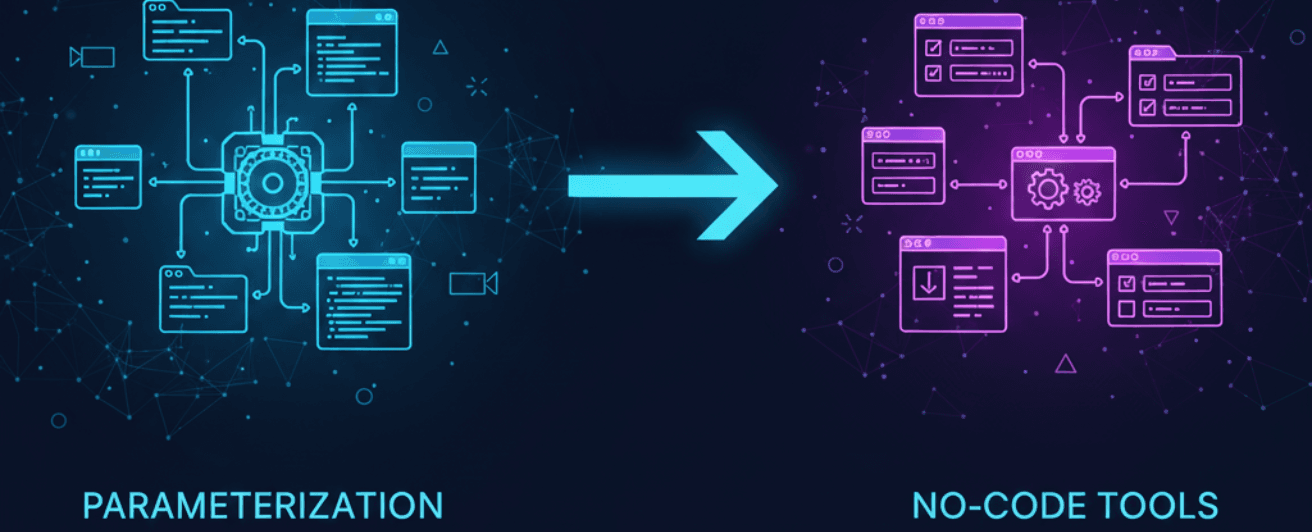
Software testing often involves repeating the same logical flows with different data. Testing multiple users, product variations, payment options, or API payloads. This repetition can quickly inflate the number of test cases and make maintenance a constant struggle. Parameterization solves this problem by introducing flexibility and reusability into automation. It allows testers to define dynamic data once and apply it across different parts of their testing framework, without duplicating logic.
Modern automation frameworks and tools use it across elements, reusable components, configurations, and environments, allowing one design to adapt to countless scenarios. This approach ensures that test automation stays efficient, scalable, and easy to maintain, even as systems evolve.
This article explores how parameterization works in automation testing, the challenges of implementing it in scripted frameworks, and how modern no-code platforms like Sedstart simplify multi-level parameterization for faster, more maintainable testing.
What Is Parameterization in Automation Testing?
Parameterization in automation testing refers to the process of making your tests dynamic by replacing static values with variables or parameters. These parameters can represent anything from a user credential to an entire configuration setting, and they allow a single test flow or reusable component to execute under multiple data conditions.
For example, consider an e-commerce checkout process. Rather than creating separate workflows for different payment methods or regions, parameterization lets testers define variables like payment type, currency, and region. During execution, these variables pull their values from external sources such as spreadsheets, databases, or APIs, automatically adapting the same logic to every context.
This concept is at the heart of data-driven and modular testing. It ensures that automation is flexible enough to handle real-world variability without additional coding. Whether applied at the level of elements, components, data, or environments, parameterization keeps test suites compact, maintainable, and responsive to change.
By understanding its role as a foundation for scalable automation, it becomes easier to see why traditional scripted parameterization often falls short and how no-code platforms are closing that gap.
Use Cases of Parameterization
Parameterization supports dynamic testing across virtually every industry and application type. By separating logic from data, teams can reuse test flows in different business contexts without rewriting or reconfiguring scripts.
Here are some common examples of where it delivers value:
- E-commerce: Run checkout or product search flows using varying products, discount codes, or payment methods.
- Banking and Finance: Validate multiple transaction types, account categories, and authorization levels using secure datasets.
- Healthcare: Test form validations, patient records, and appointment systems using parameterized patient IDs and data sets.
- SaaS Platforms: Check user roles, subscription tiers, and permissions dynamically across environments.
- API Testing: Execute the same endpoints with different payloads, headers, or tokens to validate data consistency and response handling.
- Cross-Environment Testing: Switch between development, staging, and production environments using environment-level parameters instead of separate test scripts.
Each of these use cases shows how parameterization transforms static test designs into reusable, data-driven systems that adapt effortlessly to new conditions.
Challenges in Traditional Parameterization (Scripted Automation)
Parameterization is a well-established concept in code-based testing frameworks such as Selenium, TestNG, and JUnit. However, its implementation in these environments often introduces avoidable complexity and maintenance overhead. Here are the key challenges QA teams commonly face:
- Requires programming expertise: Testers must write and maintain code to define variables, loops, and data bindings. Even minor data updates, such as changing an environment URL or credential, require code edits and retesting.
- High maintenance overhead: Parameterized scripts are often scattered across multiple files and classes. As test suites grow, managing data dependencies becomes time-consuming and error-prone.
- Fragmented data management: Parameters are frequently stored in separate configuration files, embedded in code, or linked to external datasets with manual mapping. This fragmentation makes it difficult to trace data usage or ensure consistency.
- Limited collaboration: Non-technical testers struggle to contribute because parameterization setup relies heavily on scripting and framework knowledge. This dependence on technical users reduces agility and slows the overall testing process.
- Reduced scalability: As more tests and datasets are added, scripts become increasingly complex, leading to redundant logic and slower execution cycles.
These limitations reveal a clear need for a simpler, more accessible approach; one that retains the flexibility of parameterization but removes the technical barriers of traditional scripting.
How No-Code Tools Simplify and Accelerate Parameterization
No-code automation fundamentally redefines how parameterization is designed, applied, and maintained. Instead of writing and maintaining scripts, testers can create and manage parameters through a visual interface. Here’s how no-code platforms streamline the process:
- Define parameters visually: Testers can create variables such as email, password, or product ID directly within the interface, without coding syntax or script editing.
- Add or connect data sources: Datasets can be imported from CSV, Excel, APIs, or internal databases. These sources are managed inside the platform, ensuring consistency and reducing the chance of errors.
- Map parameters to elements or reusable components: With simple drag-and-drop functionality, variables can be connected to UI fields, reusable flows, or environment configurations.
- Execute once, reuse everywhere: The same automation design can run seamlessly across multiple datasets, browsers, and environments through parameterized execution.
This multi-level approach delivers measurable advantages:
- Eliminates repetitive scripting by allowing one test to adapt to many conditions.
- Accelerates execution as parameterized tests automatically loop through multiple data sets.
- Simplifies maintenance by updating parameters in one place and applying changes system-wide.
- Expands test coverage across user roles, configurations, and environments without extra setup.
- Reduces manual workload through automated data substitution ideal for regression or functional testing.
- Improves CI/CD integration by supporting dynamic, environment-aware executions after every build.
- Enhances scalability through reusable, parameterized components that can be shared across projects.
Together, these capabilities make parameterization an integrated part of the test design process rather than a separate technical task. By removing the scripting layer and automating data reuse, no-code tools help QA teams focus on strategy, coverage, and continuous quality improvement instead of maintenance. Parameterization thus becomes a cornerstone of sustainable, large-scale automation.
How Sedstart Automates Parameterization Without Code
Sedstart brings parameterization to life through a visual, no-code interface that eliminates the need for scripting while maintaining flexibility and precision. Instead of defining parameters in code, testers can configure dynamic data, reusable components, and environment variables directly within the platform. This design-first approach ensures that parameterization happens naturally as part of test creation, not as an afterthought.
Here’s how Sedstart simplifies multi-level parameterization:
- Auto-parameterization: You can rename any value as a single word without spaces. These are automatically converted into variables that you can define.
- Dynamic data mapping: Variables can be linked to datasets from sources like CSV, Excel, or APIs. Sedstart automatically substitutes the correct values at runtime.
- Expression-based logic: Testers can define conditions and rules visually to control how data is applied across tests such as running specific variations for certain user types or environments.
- Environment-level data handling: Sedstart manages environment-specific parameters (like base URLs, credentials, or configurations) automatically, enabling seamless transitions between staging, QA, and production setups.
- Parallel execution and scalability: Tests run simultaneously across browsers, APIs, and devices, with parameters dynamically applied to each instance.
- Built-in security for sensitive data: Credentials and tokens can be securely stored and parameterized without exposing them in test logic.
- Native CI/CD integration: Parameterized workflows can be triggered automatically during deployment pipelines using Sedstart’s CLI.
By combining these capabilities, Sedstart moves parameterization beyond code-driven data handling to a more intelligent, workflow-oriented model. Teams can scale automation quickly while maintaining transparency, security, and control, all without writing a single line of code.
Smarter Testing Through Dynamic Data
Parameterization is more than just a testing technique; it’s a design philosophy that transforms automation from static repetition into scalable, adaptable workflows. By separating logic from data, QA teams can reuse the same automation across environments, users, and configurations, ensuring better coverage and faster execution.
Traditional scripted approaches made this flexibility possible but complex, locking parameterization behind code and framework rules. No-code platforms like Sedstart bring the same power to every tester, letting teams define, reuse, and scale parameters visually across all levels from elements and components to environments and datasets.
By automating data handling and simplifying design, Sedstart turns parameterization into a seamless part of everyday testing. It reduces maintenance overhead, accelerates delivery cycles, and allows QA teams to focus on what truly matters: quality at scale.
With Sedstart, teams can automate hundreds of data-driven test cases in minutes, no coding required. Book a free demo today!